The Gardener Schools’ Award

Our unique Gardener Schools’ Award is an innovative and creative curriculum that fosters intellectual curiosity, creative and critical thinking, and a global mindset. The aim is to develop pupils’ love for learning by exposing them to an array of opportunities in which they must navigate and explore without the focus of exam preparation and success.

The Gardener Schools’ Award at Maida Vale School is a bespoke curriculum for Years 7 & 8, which pupils follow for their first two years at school. Pupils graduate from the Award at the end of Year 8 in a special ceremony, where their best work and achievements from the past two years are showcased. Maria Gardener, the school’s founder, will present the Awards, which include additional accolades for pupils who have demonstrated exceptional skill.

The five strands of the Gardener Schools’ Award are:

  • Enterprise: collaboration, communication, careers, law and order, technological literacy
  • Perspectives: global outlook, critical thinking, empathy, mindfulness
  • Well-being: relationships and sex, personal, social, health and economic (PSHE) education, resilience, adaptability, healthy habits
  • Community: leadership, global citizenship, empowerment, environmental awareness, community service, volunteering
  • Creativity: innovation, design, problem solving

The Award focuses on honing the salient skills required for the modern workplace, while delivering valuable, dynamic content.

Teaching and learning takes place in four 90 minute lessons a day, with two strands being the focus in at least four subject areas for the first five half terms of each academic year.

These strands are reinforced in our PSHE lessons, namely Individuals in Society, as well as our school assemblies. Each half term, a variety of subjects work together in interdisciplinary projects, resulting in pupils moving between two-three subjects aware of the overarching thread tying together their learning in those disciplines. Here, exciting connections are made and impressive results produced while pupils become increasingly aware of the links between skills and knowledge across their curriculum.

In the final half term of the year, the focus is on consolidating the five strands in Individuals in Society lessons. For additional Award credit, pupils have the chance to extend one of their interdisciplinary projects, redrafting and developing it and submitting it as a final piece of the year.

Additionally, twice a year, the normal structure of the day is suspended to allow space for two Gardener Schools’ Award Days: external speakers, off-site visits, on-site projects, productions and showcases are undertaken allowing pupils hours of uninterrupted focus on the Award strands and crucial creative and critical thinking skills.

Grading

  • 10 interdisciplinary projects/year (none in the second half of the Summer Term).
  • Pass, Merit, Distinction EITHER for each interdisciplinary project OR for each subject within the project.
  • Termly and annually, the average of Ps, Ms, Ds is monitored in Individuals in Society.
  • Individuals in Society will have termly projects and P, M, D grading.
  • Enrichment involvement will be graded P, M, D (or nothing if no engagement).

Details for the Gardener Schools’ Award in Year 7 can be found as follows:

Community

Autumn Term

Departments: Science and Design & Technology

How do my actions affect others?

Undertaking school walk arounds, as well as exploring the Science Labs and D&T Workshop and machines, pupils will create their own safety advice for optimal learning in safe environments. By identifying hazards and deciding on solutions and pre-emptive measures, pupils will also act as safety monitors in their own lessons, instructing and teaching each other the importance of following the rules and avoiding disaster.

Spring Term

Departments: Drama & French

Do you understand my community and me?

Focusing on the topics, pets and colours, pupils will immerse themselves in learning about life in France, mastering new and ambitious French vocabulary (which can be further embedded on the French trip to the Institut Français). In Drama working in small group communities, pupils will learn about script writing, based on different communities.

Perspectives

Autumn Term

Departments: Geography and Maths

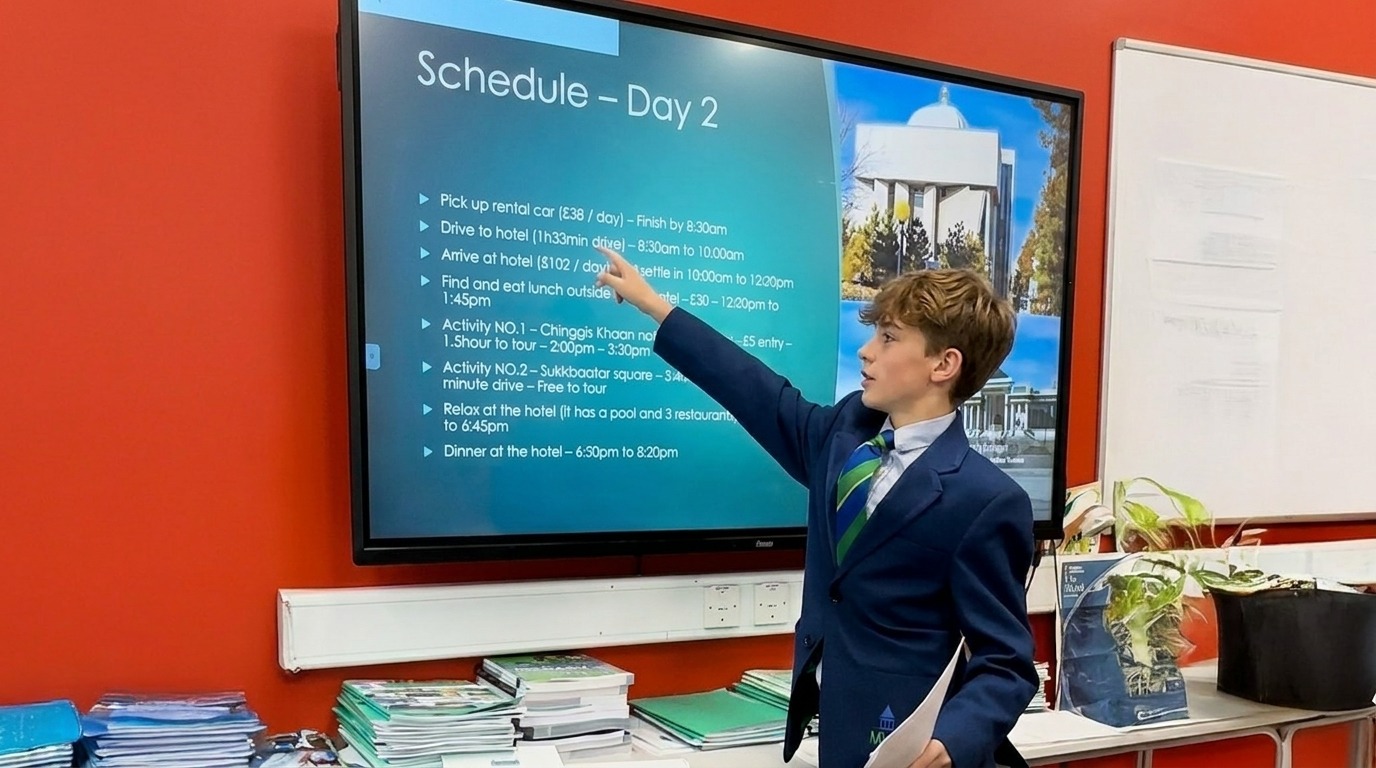
Why do we travel? Exploring our world, on a budget.

Pupils will master mathematical calculations and the interpreting of data so that they can critically evaluate their own travel, both past and future. While grappling with the finances of budgeting, pupils will identify both physical and human geographical features in a variety of countries and continents.  Pupils’ organisation and performance skills will be put to the test in their final presentations, after which they should receive their Exploratory Passport.

Summer Term

Departments: Food Preparation & Nutrition and Art

After some research, pupils will choose a culture (not their own) and deepen their understanding of it. Through both independent and group work, they will cultivate an information display including a menu of traditional dishes. After trialling multiple recipes, pupils will choose their favourite and produce this, serving it to parents and pupils at the Gardener Award showcase in the summer term.

Wellbeing

Autumn Term

Departments: Art and Latin

What has Design got to do with Well-being?

Kicking off with a visit to the British Museum, pupils will immerse themselves in Roman life before delving deeper into the design of ancient homes in Pompeii. Discovering that the design of a Roman home was salutary, and closely connected to the natural world pupils will compare these ancient designs to their own homes. Pupils will design and craft a clay relief tile, which will form part of a final mosaic of tiles, as well as produce a contextual research explanation supporting their design.

Spring Term

Departments: Spanish and Physical Education

Can you beat me to Barcelona?

In this Race to Barcelona, pupils must use various forms of exercise to cover the distance between London and Barcelona. Tracking their cumulative distances, pupils will construct an ongoing presentation – in any form – highlighting the benefits of their types of exercise on physical and psychological fitness. In Spanish lessons, pupils will produce a diary (written or spoken) in which they describe the different modes of transport and exercise; the distinct legs of their journey; the distances, and much more.

Enterprise

Autumn Term

Departments: English and Drama

What’s in a name? The Game of Life.

Working collaboratively, pupils will create and name their own city, filling it with characters and taking inspiration from a variety of extracts of novels and plays from around the world. Devising problems that their characters must solve and overcome, pupils will write and perform persuasive Mayoral election speeches.

Spring Term

Departments: Music and Science

Is there science behind music?

Having grasped new software, pupils will compose their own piece of music using Logic. Then, exploring pitch, amplitude and waves in Physics, pupils will produce a scientific report analysing their composition.

Creativity

Spring Term

Departments: English and History

Are villains ever victims?

While investigating historic villainous behaviours, both factual and fictious – namely Richard III, Lady Macbeth, Catherine of Aragon, Mary I, Prospero and Elizabeth I – pupils will create visual depictions of villains, closely evaluate sources, apply contextual knowledge, and decide whether or not any of these villains can be considered victims.

Summer Term

Departments: Maths and Computer Science

Why is data significant?

Undertaking real world application of statistics, this project culminates in the production of a factual news article. Pupils will understand the complications that come with analysing and interpreting data and have the confidence to use Excel to represent their data and present their findings.